11
May 2026
Legacy Data Center Retrofit: Converting Uptime and Power-Cost Risk into Contracted Availability Discipline
Sir Felix Modebe | N3 Capital Africa | IC-Grade Allocator Lens™ on Africa Real Asset Platforms
Executive Snapshot
- Asset / Sector /: Legacy data center retrofit into an efficiency and capacity-reclaim platform
- Geo: Johannesburg, South Africa.
- Problem: Uptime fragility and power-cost opacity weakened confidence in contracted revenues.
- Intervention: Infrastructure retrofit + instrumentation + contract governance upgrades.
- Control Stack: Availability KPIs, power cost pass-through gates, reserves, step-in for FM/O&M, evidence-led reconciliation.
- Outcome: The asset underwrites as availability-based digital infrastructure exposure—documented, monitorable, and enforceable.
1) Before → After – Mechanism-Led
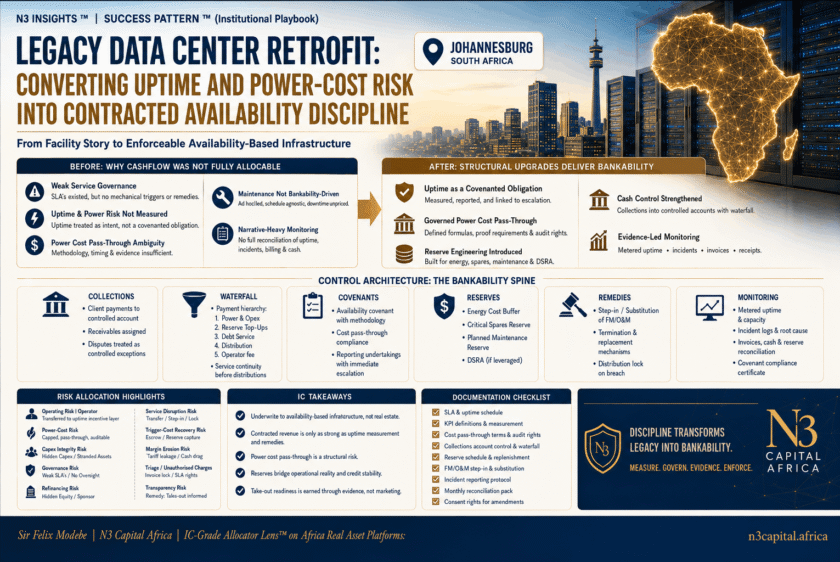
Before (why the cashflow was not fully allocable)
Legacy data centers often present as “contracted revenue.” The underwriting failure typically sits elsewhere: not in demand, but in the operating system that converts service delivery into cash.
Key failure modes observed in legacy facilities include:
- Service performance existed but was weakly governed. Contracts may define service levels, but do not define what happens—mechanically—when they are missed.
- Power availability risk was treated as operator competence rather than measured obligation. Where uptime is not covenanted and evidenced, credit committees are underwriting managerial intent.
- Power cost pass-through was ambiguous. Even when contracts reference energy cost recovery, the methodology, timing, and evidence requirements are often insufficient to prevent margin compression under stress.
- Maintenance cycles were not governed as a bankability input. Without a funded and scheduled maintenance regime, downtime risk is underpriced and typically surfaces as “unexpected” incidents.
- Monitoring was narrative-heavy. Too many packs summarize service performance without tying (i) metered evidence, (ii) incident logs, (iii) billing, and (iv) bank receipts into a single reconciliation chain.
The result: lenders and long-duration capital see “contracted revenue,” but cannot see enforceable availability.
After (what changed structurally)
A bankable retrofit program does not merely upgrade equipment. It upgrades the documentation and control architecture that makes contracted revenue durable.
The “after” state is defined by five upgrades:
- Availability metrics become contractual obligations with triggers and remedies. Performance is defined, measured, and linked to escalation.
- Power cost pass-through becomes governed. Costs are recovered through a defined formula, proof requirements, and audit rights—removing ambiguity.
- Reserve engineering is introduced to absorb operational shocks. Critical spares and planned maintenance are funded and replenished with priority.
- Cash control is improved. Collections flow into controlled accounts with permitted payments governed by waterfall discipline.
- Monitoring becomes evidence-led. Monthly reporting reconciles: metered uptime + incidents + invoices + receipts + reserve movements.
This is the pivot from “facility story” to contracted availability discipline.
2) Repositioning Thesis (What was engineered)
Cashflow durability: The thesis is not demand growth. It is enforceable availability and cost recovery—turning uptime into a measured, audited obligation and ensuring power cost does not silently erode debt service coverage.
Control architecture: Contracts and cash are aligned. The collection system, the waterfall, the covenant tests, and the reporting cadence all reference the same measurable evidence base.
Governance: Change controls are explicit—pricing amendments, scope adjustments, and service-level modifications require documented approvals and, where relevant, lender consent.
Take-out readiness: Refinancing depends on proof: a credible performance history, stable reconciliation discipline, and covenant behavior under stress. Take-out is earned through documentation, not marketing.
3) Control Architecture (The Bankability Box)
Below is the control spine that turns a retrofit into an institutional-grade exposure.
Collections
- Client payments flow into a designated controlled collections account.
- Where feasible, receivables are assigned and cash dominion is established through account control arrangements.
- Disputed amounts are treated as controlled exceptions, not informal delays.
Waterfall
A disciplined payment hierarchy is documented and enforced, typically:
Power and essential Opex → Reserve top-ups → Debt service → Permitted distributions
This ensures service continuity is protected before equity extraction.
Covenants
A DSCR covenant is necessary but not sufficient. Add the performance overlays that act earlier than DSCR:
- Availability covenant: measured uptime thresholds with defined reporting methodology.
- Cost pass-through compliance covenant: documentary proof and auditability of cost recovery.
- Reporting undertakings: failure to deliver evidence triggers immediate escalation (not “noted for next month”).
Reserves
Reserve buffers are the difference between a stable credit and an “incident-prone” asset:
- Energy cost buffer reserve: bridges power-cost spikes and timing gaps.
- Critical spares reserve: prevents prolonged downtime due to procurement delays.
- Planned maintenance reserve: funds lifecycle discipline.
- DSRA (if leveraged): with replenishment priority in the waterfall.
Remedies
Remedies must be executable and time-bound:
- Step-in / substitution rights to replace FM/O&M provider after defined KPI failures.
- Termination and replacement mechanics for persistent service failure, with continuity arrangements for critical operations.
Monitoring
Monthly monitoring should reconcile the full chain:
- Metered uptime reports and capacity utilization
- Incident logs and root-cause categorization
- Invoices issued and adjustments applied
- Cash received (bank statements)
- Reserve balances and movements
- Covenant compliance certificate
Anything less is narrative.
4) Risk Allocation (Narrative Format)
Operational risk remains the primary risk holder in data centers. The repositioning objective is not to eliminate it, but to convert it into measurable obligations with enforceable remedies.
- Operational risk holder: FM/O&M operator
- Mitigant: availability covenant + maintenance schedule + reserves
- Monitoring trigger: uptime breach, repeated incidents, SLA non-compliance
- Remedy: step-in/substitution; distribution lock until performance normalizes
- Power-cost risk holder: the structure, unless explicitly allocated
- Mitigant: governed pass-through methodology + energy buffer reserve
- Monitoring trigger: cost recovery delays, variance beyond defined bands
- Remedy: reserve draw + mandatory replenishment; tighten permitted payments
- Counterparty risk holder: clients (partially) and the lease/contract structure
- Mitigant: deposits/credit support where available; dispute containment; receivables control
- Monitoring trigger: arrears aging and dispute frequency
- Remedy: cash trap; service suspension/termination where contract permits
- Governance risk holder: sponsor/operator
- Mitigant: consent rights over contract amendments and material capex
- Monitoring trigger: unauthorized changes, leakage, late reporting
- Remedy: distribution lock; enhanced reporting; step-in rights
- Refinancing risk holder: equity/sponsor
- Mitigant: documented performance history + covenant compliance record
- Monitoring trigger: instability in KPI performance or reconciliation discipline
- Remedy: take-out deferred until seasoning is evidenced
5) IC Takeaways (Allocator Lens)
- Data centers underwrite as availability-based infrastructure, not as real estate.
- “Contracted revenue” is only as strong as the measurement and remedies behind uptime.
- Power cost is a structural risk: if pass-through is ambiguous, your DSCR is fragile.
- Reserve engineering is not a nice-to-have. It is the bridge between operational reality and credit stability.
- Take-out readiness is built on an auditable performance record and evidence-led monitoring—nothing else substitutes.
6) Documentation Checklist (Deal Readiness)
SLA and uptime schedule | KPI definitions and measurement methodology | cost pass-through terms | audit rights | collections account control | waterfall and permitted payments | reserve schedule and replenishment priority | FM/O&M step-in and substitution | incident reporting protocol | monthly reconciliation pack | consent rights for amendments
7) Closing
A legacy data center becomes bankable when uptime stops being an aspiration and becomes a covenanted, monitored, and enforceable obligation—supported by cash control, reserve buffers, and a documented escalation ladder.