19
May 2026
THERMAL-TO-BATTERY REPOSITIONING: Converting Dispatch and Settlement Risk into Contracted Capacity Discipline
Sir Felix Modebe | N3 Capital Africa | IC-Grade Allocator Lens™ on Africa Real Asset Platforms
Executive Snapshot
Battery storage repositioning on a legacy thermal generation site is often framed as a transition narrative. Institutional underwriting treats it as a payment-and-performance system. The credit question is not whether storage is “the future,” but whether cashflows are measurable, verifiable, and enforceable through cycles. In frontier and emerging markets, failure modes tend to cluster around settlement mechanics, evidence gaps, and augmentation lifecycle risk rather than pure technology risk. This note sets out a mechanism-led playbook that converts those risks into a bankable control stack: availability KPIs, settlement proof gates, reserve engineering, and operator enforceability.
1) Before → After: The Mechanism Shift
Before: Market narrative, weak cashflow discipline
Many “storage revenue” stories are presented as optionality—arbitrage, ancillary services, or system balancing. Yet credit impairment usually begins elsewhere: how payments are computed, what evidence supports them, and how disputes interrupt cash.
Three structural weaknesses recur:
- Settlement ambiguity: cashflows depend on formulas, baselines, dispatch instructions, and metering datasets that are not cleanly governed. If a counterparty can delay or dispute settlement without consequence, DSCR becomes a theoretical ratio rather than an enforceable protection.
- Degradation treated as a footnote: degradation and augmentation are often described technically, but in credit terms they are capex timing risk and performance drift risk—both of which can silently erode availability and contracted payments.
- Generic monitoring: reporting is frequently high-level. Few structures require an auditable chain from dispatch instruction → metered outcome → settlement statement → bank receipt, with clear remedies when the chain breaks.
After: Revenue as a governed payment system
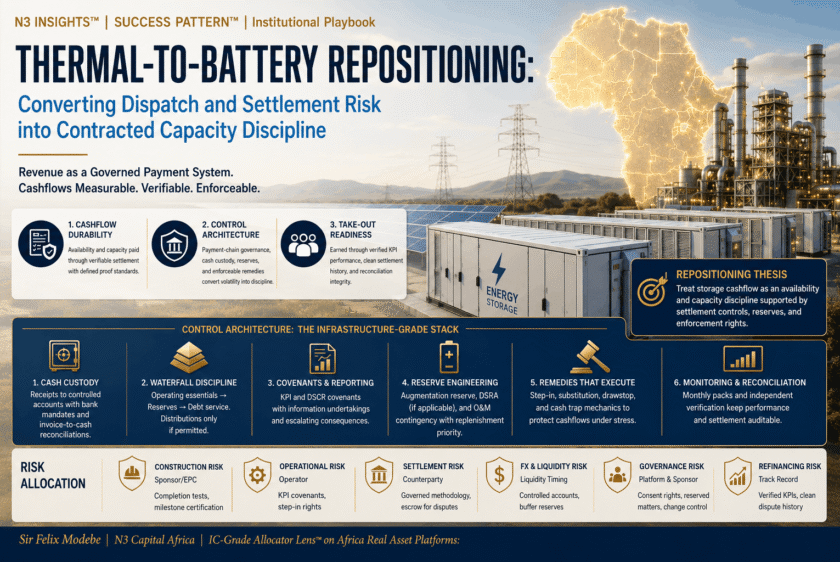
In an infrastructure-grade design, revenue is not “expected”; it is proven. The repositioning thesis is to treat storage cashflow as an availability/capacity discipline supported by settlement controls, reserves, and enforcement rights.
The upgraded architecture typically includes:
- Settlement methodology hard-coded: definitions, timelines, dispute handling, and evidence requirements become contractual, not operational “best efforts.”
- Augmentation risk converted into reserve discipline: augmentation is funded through a governed reserve with replenishment priority, preventing gradual underinvestment that later collapses availability.
- EMS/O&M enforceability: KPI breaches are mapped to clear escalation—cash trap, drawstop, and step-in / operator substitution—so governance remains executable under stress.
- Early escalation ladder: a pre-defined response to volatility avoids drifting into waiver culture when dispatch variability appears.
2) Repositioning Thesis: What Makes Storage Underwrite Like Credit
Institutional underwriting becomes feasible when three conditions are met:
- Cashflow durability
Storage becomes credit-worthy when revenue is tied to measurable availability/capacity with a documented settlement proof standard. The core underwriting unit is not “energy upside,” but availability delivered and paid. - Control architecture outranks narrative
The decisive protections are not forecasts. They are payment-chain governance, cash custody, and evidence gates that determine whether the project behaves as a contracted service platform. - Governance and consent control
Institutional platforms do not leave critical value drivers to informal change. Contract amendments, EMS changes, augmentation plan deviations, and related-party arrangements should be governed through reserved matters and consent rights. - Take-out readiness is engineered
Refinancing is not assumed; it is earned. The asset must build a refinanceable record: stable KPI performance, dispute-contained settlement, clean reconciliation, and documentation discipline.
3) Control Architecture
This is the minimum “infrastructure-grade” control stack typically required to convert dispatch and settlement volatility into contract discipline.
A) Collections and cash custody
- Settlement receipts routed into controlled accounts with clear bank mandate governance.
- Monthly invoice-to-cash reconciliation as a covenanted deliverable.
- Disputed amounts directed into escrow (or segregated account logic) to prevent leakage and preserve traceability.
B) Waterfall discipline and leakage controls
A simple hierarchy is used, with distributions last:
- Operating essentials within an approved budget
- Statutory payments and required insurances
- Augmentation reserve funding and replenishment
- DSRA (if leveraged) and other mandated reserves
- Senior debt service
- Distributions only if permitted
Leakage control is not the existence of a waterfall—it is the rule that distributions are a permission that switches off automatically when triggers are met. Discretionary capex outside the approved augmentation plan is prohibited or tightly consented.
C) Covenants, triggers, and information undertakings
- Availability/capacity KPI covenant (defined measurement, testing period, and cure protocol).
- DSCR covenant paired with settlement-timing triggers so the structure tightens before DSCR “formally” breaks.
- Information undertakings: metering data, dispatch logs, settlement statements, and reconciliation packs delivered on a defined cadence, with consequences for lateness or inconsistency.
D) Reserve engineering with replenishment priority
- Augmentation reserve policy: governed by an agreed replacement/augmentation framework, with clear rules on eligible spend, approvals, and replenishment.
- DSRA (if applicable): strict replenishment priority and constraints on draw usage.
- O&M contingency reserve for critical spares and defined replacement items.
E) Remedies that actually execute
- Step-in / operator substitution rights tied to KPI failures and operational non-performance.
- Drawstop and cash trap mechanics when reserve minimums fall below coverage or when settlement evidence fails.
- Contractual rights to replace EMS/O&M provider and control system credentials and operating mandates to ensure continuity.
F) Monitoring cadence and reconciliation standards
- Monthly: metered output, availability, dispatch events, settlement statements, collections, reserve movements, and variance commentary.
- Quarterly (or periodic): independent verification of metering/performance and sampling of settlement proof to maintain auditability.
4) Risk Allocation Summary: How the Structure Prices Reality
This is not a narrative of risks; it is an allocation of who bears them and how the structure responds.
- Construction risk: allocated to Sponsor/EPC via completion tests and milestone certification; remedy is drawstop and controlled disbursements.
- Operational risk: allocated to operator through KPI covenants and performance undertakings; remedy is step-in/substitution, not persuasion.
- Counterparty/settlement risk: managed through settlement methodology governance, dispute containment, and escrow logic for disputed amounts.
- FX and convertibility timing risk (if applicable): treated as a liquidity timing issue, mitigated by controlled accounts, conversion evidence tracking, and buffer reserves.
- Governance drift risk: contained through consent rights over EMS changes, augmentation plan deviations, contract amendments, and related-party arrangements.
- Refinancing risk: reduced by building a track record of verified KPI performance and dispute-controlled settlement history.
- Concentration risk: tested where revenue relies on a single market mechanism, payer, or settlement channel, with tightening mechanics if concentration increases.
5) IC Takeaways
- Storage bankability is driven by settlement discipline plus augmentation reserve engineering, not technology optimism.
- KPI covenants without enforceable remedies are soft protection; availability without step-in is not control.
- Take-out readiness is earned through a clean dispute record, verified KPI history, and reconciliation integrity—evidence that the platform is governable, not merely operable.
6) Documentation Checklist
Settlement methodology | Metering verification standard | KPI covenant schedule | Augmentation reserve policy | Waterfall and restricted payments | Controlled accounts and mandates | Step-in and substitution rights | Consent rights and reserved matters | Reporting and reconciliation pack | Dispute and escrow mechanics.
Closing
Grid-scale storage underwrites like credit only when dispatch outcomes, settlement economics, and lifecycle augmentation are governed as enforceable systems. The institutional edge is not complexity; it is mechanism clarity—definitions, evidence, reserves, and remedies that keep cashflows measurable and protected when volatility arrives.