04
May 2026
Port-to-Inland Corridors: Structuring Bankable Logistics Platforms Across Africa’s Gateway Cities
By Sir Felix Modebe B.Sc., M.Sc., MBA, FRICS, CCIM, KSJI
Visionary Founder-Leader | N3 CAPITAL AFRICA
Port-to-inland logistics is often discussed as transport infrastructure. Institutional capital underwrites it differently—as a cashflow architecture problem defined by revenue enforceability, cashflow hierarchy, governance enforceability, and refinancing visibility. Throughput alone does not create allocability. Volume without payment ring-fencing, diversified tenancy, and operating-node control produces operational relevance but weak structural bankability.
The primary structural theme here is refinancing readiness through cashflow control architecture.
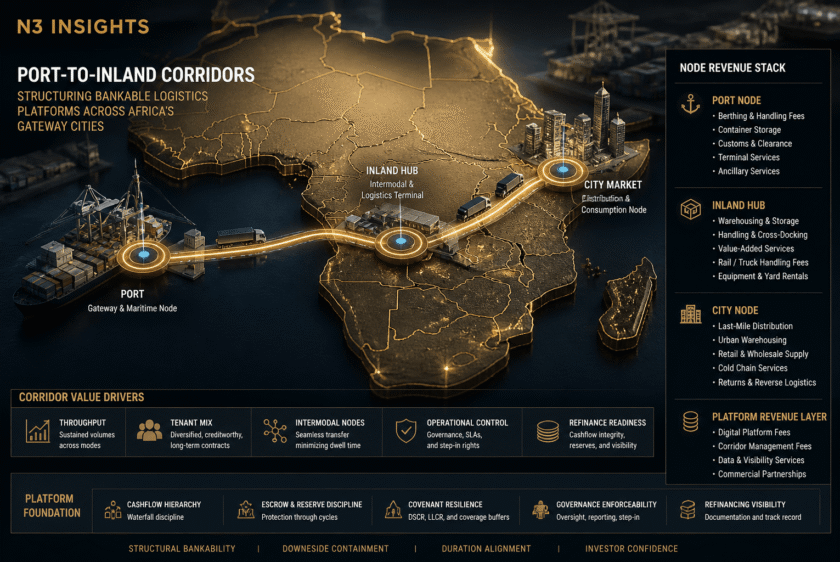
The appropriate revenue framework is typically lease-based + tariff-indexed + concession-layered, combining contracted warehousing income, throughput fees, inland terminal handling charges, cold-chain service revenues, truck park monetisation, and ancillary utility/service concessions. Risk transfer architecture should separate AssetCo operational risk, tenant covenant risk, and HoldCo capital allocation risk, with explicit default isolation between nodes. Cashflow hierarchy should follow strict waterfall sequencing: operating expenditure → maintenance reserve → senior secured debt service → DSRA replenishment → covenant buffer reserve → permitted distributions. Enforcement should sit within account control agreements, trustee-administered payment ring-fencing, and step-in rights over operating nodes.
That is what converts a corridor from infrastructure concept into institutional platform.
Structural Diagnosis
Weakly structured corridor platforms fail in familiar ways.
First, revenue concentration risk is routinely underestimated. A corridor anchored by one commodity flow, one importer group, or one logistics operator creates hidden volatility concentration. When cargo patterns change, the platform’s cashflow hierarchy weakens immediately.
Second, corridor assets are often financed as discrete projects rather than integrated platforms. Port terminals, bonded warehousing, rail sidings, inland depots, truck parks, and cold-chain facilities are treated as separate operating businesses with fragmented governance rather than one structured revenue system. That creates structural leakage, weak reporting discipline, and poor lender visibility into consolidated coverage ratios.
Third, reserve architecture is commonly underbuilt. Major maintenance for heavy logistics infrastructure—yard resurfacing, handling equipment replacement, refrigeration system renewal, rail spur rehabilitation—is frequently treated as discretionary capex rather than funded reserve governance. That weakens covenant resilience during operating stress.
Fourth, refinancing pathways are rarely engineered from inception. Many corridors are financed for construction, but not documented for long-duration institutional take-out. This creates refinancing opacity precisely when scale capital is required.
Operational throughput is therefore not the institutional question. Structural discipline is.
Engineering Framework
A. Revenue Stack Diversification
The strongest corridor platforms build layered revenue frameworks:
- contracted anchor warehousing leases
- throughput handling tariffs
- cold-chain service contracts
- truck staging and parking fees
- utility concessions (power, water, digital infrastructure)
- bonded logistics and customs processing revenues
This broadens duration alignment and improves shock absorption.
A useful covenant framework:
KPI → tenant concentration above 35% of gross revenue
Trigger → distribution gating + mandatory diversification plan
Remedy → minimum two additional contracted anchor users within 12 months
B. Escrow Discipline
Every major receivable should flow into controlled collection accounts.
Waterfall logic:
- Operating costs
- O&M reserve funding
- Senior secured debt service
- DSRA replenishment
- Major maintenance reserve
- HoldCo distributions
This creates payment ring-fencing and preserves cashflow integrity.
C. Intermodal Node Governance
Port-to-inland corridors should be structured as linked operating nodes with:
- substitution clauses for operators
- independent oversight reporting
- step-in rights within defined cure periods
- node-level audited reporting packs
- asset-level operating reserve controls
Node substitution capability materially improves governance enforceability.
D. Documentation Readiness
Refinanceable platforms are built for diligence from day one.
Minimum standards include:
- monthly third-party reconciliation
- quarterly covenant dashboard
- independent throughput verification
- customer receivables ageing analysis
- reserve account certification
- legal perfection of receivable assignments
That improves buyer universe proof.
Stress-Case Analysis
Under FX shock, tariff-indexed revenues with partial USD-linkage create better FX layering, but convertibility remains vulnerable unless transfer priority and trapped cash mechanics are predefined.
Under throughput disruption, diversified tenant mix and reserve buffers contain downside.
Under payment delay, controlled receivables assignment materially improves collection predictability.
Under refinancing tightening, platforms with operating history, reserve discipline, and covenant transparency preserve take-out optionality.
The distinction is simple:
Weak platforms depend on traffic forecasts.
Strong platforms depend on contractual cash capture.
Institutional Implications
For a Public Pension Fund / DFI Platform Investor, corridor platforms become allocable when four conditions are met:
- Cashflow integrity is contractually protected
- Governance enforceability is legally executable
- Duration alignment supports long-term liabilities
- Exit visibility is documented early
That clears Investment Committee thresholds.
Institutional capital allocates to enforceability—not infrastructure rhetoric.
If cashflow hierarchy preserves corridor income integrity, the next structural question becomes whether cross-border governance architecture can preserve capital when operational control sits across multiple sovereign jurisdictions.
Sir Felix Modebe | N3 Capital Africa | IC-Grade Allocator Lens™ on Africa Real Asset Platforms