
24
Mar 2026
Investment Committee Memo Series The Africa IC Memo Template: Decision Gates, Downside Cases, and Covenants
By Sir Felix Modebe B.Sc., M.Sc., MBA, FRICS, CCIM, KSJI
Visionary Founder-Leader | N3 CAPITAL AFRICA
In many frontier markets, macro conditions manifest as underwriting consequences, not headlines. FX volatility translates into cash control architecture and repatriation gates. Utility instability becomes an uptime and capex reserve question. Judicial timelines inform security perfection and remedy paths. Exit optionality depends on documentation quality and data integrity.
For Investment Committees, the implication is clear: macro risk must be converted into contractual allocation, enforceability mechanics, and monitoring cadence before capital is committed.
What Changed: From Asset Buying to Platform Underwriting
IC packets now require standardisation: a repeatable memo, exhibits, and an evidence log that traces each risk to a covenant, reserve, or governance right. Documentation has shifted toward tighter covenants, defined reporting triggers, and pre-agreed downside playbooks.
“Asset buying” underwrites a building or facility. “Platform underwriting” underwrites governance, counterparty durability, and replicability across markets.
This shift requires:
- Clear risk allocation matrices (who bears FX, construction, utilities, demand).
- Explicit remedy paths (contractual step-in, cash sweep, reserve draw, lock-up).
- Quarterly evidence logs to test assumptions against operating data.
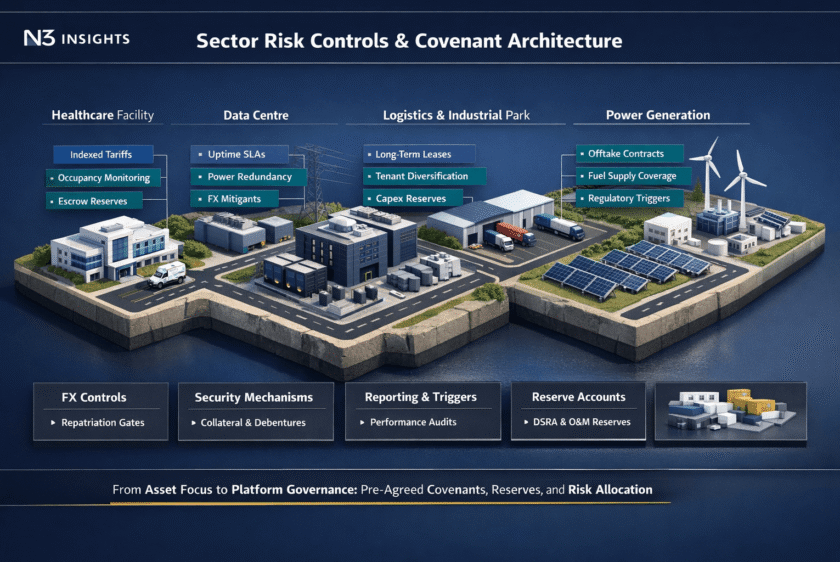
Sector Controls: What Investors Pay For, What Breaks Bankability, How to Fix It
Healthcare (Hospitals / Clinics)
Investors pay for contracted revenue (insurance panels, government service agreements), occupancy durability, and indexed tariffs where feasible. Bankability breaks under FX mismatch (local revenue vs hard-currency debt), unclear land title, or capex backlogs.
Controls: FX risk allocated to sponsor via equity buffers or tariff indexation where permitted; enforceability through charge over receivables and defined step-in rights; monitoring via monthly occupancy, payer mix, and capex variance triggers. Lifecycle reserves and insurance escrow accounts mitigate operational shocks.
Data Centres
Investors pay for long-term leases, uptime SLAs, and creditworthy anchor tenants. Bankability fails under unreliable grid power, convertibility constraints, or concentration risk.
Controls: Utilities risk allocated contractually to operator with performance-backed SLAs; enforceability via direct agreements with tenants and collateralised receivables; monitoring through uptime reporting triggers and power redundancy audits. Reserve accounts (DSRA and O&M) protect debt service during outages. FX mitigants include offshore collection accounts where permitted and dividend gating protocols.
Logistics / Industrial Parks
Investors pay for lease tenor, tenant diversification, and indexed rental streams. Breakpoints include title disputes, zoning delays, and infrastructure bottlenecks.
Controls: Title insurance or equivalent security perfection; enforceability through mortgage debentures; monitoring via lease rollover dashboards and tenant concentration triggers. Capex reserves ring-fenced to prevent deferred maintenance.
Power-Adjacent Infrastructure (Captive or Embedded Generation)
Investors pay for contracted offtake and tariff clarity. Bankability weakens under regulatory reversals or fuel supply disruption.
Controls: Risk allocated to offtaker through take-or-pay clauses; enforceability via escrowed tariff accounts; monitoring through fuel supply coverage ratios and regulatory change triggers.
Country Notes: Control Implications by Market
Nigeria: FX pathway requires structured repatriation planning; title security varies by state; permitting can be sequential; grid reliability inconsistent. Risk allocation must assume sponsor equity buffers. Enforcement practical but procedural. Monitoring: quarterly FX coverage reviews.
South Africa: Stronger title regime and enforcement track record; utilities risk elevated. FX convertibility manageable but volatility present. Monitoring: load-shedding exposure audits and covenant headroom reviews.
Kenya: Active PPP framework; FX convertibility historically functional but episodically tight. Title clarity improving. Enforcement moderate. Monitoring: currency liquidity stress tests and lease enforceability reviews.
Ghana: Convertibility constraints episodic; permitting transparent but time-sensitive. Utilities reliability variable. Enforcement practical with documentation discipline. Monitoring: cash sweep triggers if DSCR/LLCR fall below illustrative floors.
Côte d’Ivoire: Franc-zone FX regime provides relative convertibility clarity; title and permitting processes structured but relationship-driven. Utilities comparatively stable. Monitoring: tenant credit review cadence.
Watchlist:
Tanzania: Permitting timelines require contingency buffers; FX pathway manageable but policy-sensitive.
Namibia: Smaller market; title clarity strong; liquidity depth limited.
Zambia: FX convertibility volatile; enforcement practical but capacity-bound.
Rwanda: Streamlined permitting; utilities improving; small market concentration risk.
The Control Stack: IC Checklist
- Governance: Board observer rights; reserved matters; information rights; sponsor equity lock-ups.
- Financial Covenants: Illustrative DSCR/LLCR floors; cash sweep above thresholds; distribution lock-ups; cure rights defined.
- Reserves: DSRA; lifecycle and O&M reserves; insurance escrow; capex ring-fencing.
- Reporting Triggers: Monthly operating packs; variance thresholds; uptime metrics; tenant concentration alerts.
- FX Mitigants: Ring-fenced collection accounts; dividend gating; pre-agreed contingency playbooks; sponsor equity top-up triggers.
Each item must specify risk owner, contractual remedy, and monitoring cadence. Without that linkage, the memo is incomplete.
Board Implications
First, tenor must match enforceability confidence and currency visibility. Second, pricing discipline depends on covenant strength, not narrative growth. Third, replication logic requires platform-level governance and standardised documentation. Fourth, “institutional-ready” means auditable data rooms, perfected security, and enforceable step-in rights.
At N3 CAPITAL AFRICA, we have found that IC standardisation reduces decision latency and improves downside case clarity.
Serious question for allocators: does your current IC memo template force every identified risk to show its owner, its enforceability path, and its monitoring trigger—or are you still underwriting assets instead of governance?