26
Jan 2026
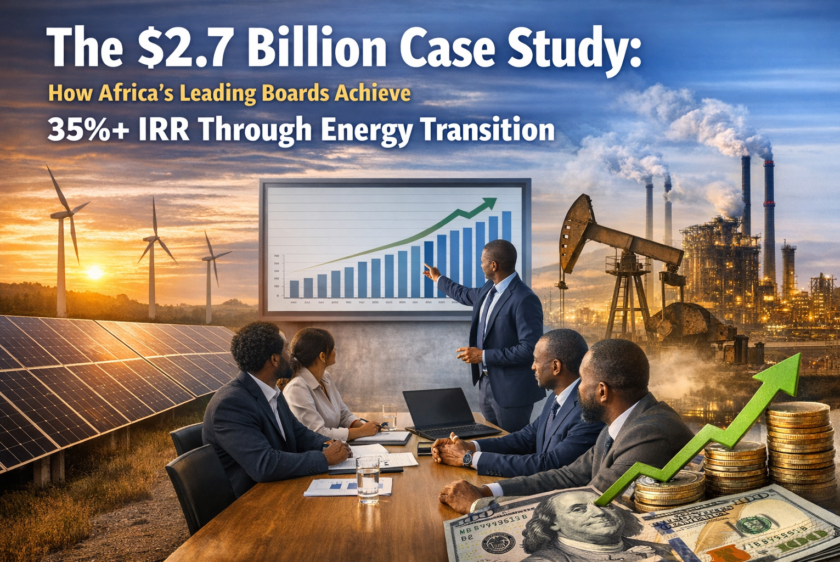
The $2.7 Billion Case Study: How Africa’s Leading Boards Achieve 35%+ IRR Through Energy Transition
By Sir Felix Modebe B.Sc., M.Sc., MBA, FRICS, CCIM, KSJI
Visionary Founder-Leader | N3 CAPITAL AFRICA
Energy transition has evolved from ESG conversation to CFO-controlled capital strategy. Boards evaluating 2027 readiness face fundamental reorientation: energy infrastructure decisions now carry financial materiality comparable to capital allocation.
From Cost Line to Strategic Imperative
African corporations face 25-45% annual energy cost increases. Diesel prices escalated 180%—₦380 to ₦1,100/liter in Nigeria, KES 95 to KES 180/liter in Kenya. For corporations consuming 12,000 liters monthly, costs jumped from ₦4.6 million to ₦12 million monthly—₦7.4 million increases that budget planning cannot absorb.
Grid instability compounds challenges beyond fuel costs. Telecommunications tower downtime causes 2-5% capacity loss. Manufacturing faces production disruptions, quality complications, and supply chain failures. Branch closures and customer attrition during outages create hidden costs. Total energy-related operational drag reaches 15-20% of revenue in grid-challenged markets.
Development finance institutions controlling $52 trillion embed ESG performance as allocation criteria, creating 8-15% equity premiums for energy-optimized corporations. This isn’t environmental positioning—it’s financial materiality impacting cost of capital, asset valuations, and investor access.
The Board Question: “Where’s the ROI?”
Solar+storage deployments consistently achieve:
- IRR: 35-50% depending on baseline costs
- Payback: 3-5 years for comprehensive installations
- NPV: 3-4x initial capital over 25-year useful life
- Cash Flow: Immediate 50-70% monthly savings
These returns exceed most growth investments targeting 15-25% IRR with 5-7 year payback.
Yet comprehensive infrastructure requires substantial upfront: ₦180-250 million for campuses, ₦400-600 million for 50-branch networks, ₦500-800 million for industrial facilities. CFOs face legitimate tension: deploy capital toward energy infrastructure or market expansion?
The N3 Capital Solution: $0 Upfront
Our 15-25 year covenant structures provide comprehensive infrastructure without balance sheet deployment. IFC, AfDB, and EIB partnerships deliver capital at 200-400 basis points below market.
Representative 50-branch network: Zero upfront + ₦28M covenant + ₦8M energy = ₦36M monthly versus ₦42M traditional—₦6M savings with zero capital.
Proven Track Record: $2.7B Portfolio
Nigerian Banking (247 branches): ₦890M→₦507M monthly (43% reduction), ₦1.4B net annual benefit, 38% IRR
Kenyan Oil Marketing (156 stations): KES 92M→KES 37M monthly (60% reduction), KES 180M net annual benefit, 41% IRR
South African Manufacturing (2.5MW): ZAR 4.8M→ZAR 2.1M monthly (56% reduction), ZAR 13.8M net annual benefit, 44% IRR
The 2026 Decision Window
Regulatory frameworks establish concrete timelines. Corporations beginning implementation now achieve 2027 readiness; those delaying face compressed timelines and competitive disadvantage.
Energy transition delivers 35%+ IRR while strengthening balance sheet resilience. Through $2.7 billion in portfolio optimizations, N3 Capital enables optimal execution without balance sheet constraints.