22
Jan 2026
Lease vs. Own in Africa Corporate Real Estate: The Institutional Decision Matrix Every CFO Must Use
By Sir Felix Modebe B.Sc., M.Sc., MBA, FRICS, CCIM, KSJI
Visionary Founder-Leader | N3 CAPITAL AFRICA
The lease-versus-own decision represents one of the most consequential capital allocation choices African Chief Financial Officers (CFOs) face—yet most apply outdated frameworks that ignore total economic reality. With interest rates rising dramatically across African markets (Nigeria 27.25%, Ghana 18%, Kenya 13%, South Africa 8.25%), the opportunity cost of capital deployment to real estate has never been higher.
The Ownership Myth: “Buying is Always Cheaper”
CFOs often compare mortgage payments to lease payments and conclude ownership is cheaper. This analysis is fundamentally flawed.
Total Annual Cost Comparison ($28M Property):
Ownership:
Direct costs (mortgage, taxes, insurance, maintenance): $3,836,000 (13.7%)
Opportunity cost (capital @ 22% ROIC): $1,848,000 (6.6%)
Total Ownership Costs: $5,684,000 (20.3%)
Sale-and-Leaseback (SLB):
Base rent: $3,220,000 (11.5%)
Operating expenses: $650,000 (2.3%)
Total SLB Costs: $3,870,000 (13.8%)
10-Year NPV Advantage:
$12.7M favoring leasing—before considering capital redeployment.
When $26M released proceeds are redeployed to core business at 22% ROIC.
Total Advantage Exceeds $64M.
Hidden Ownership Costs CFOs Underestimate
Major CAPEX Cycles (Every 8-15 Years):
Roof replacement: $800K-$1.8M |
HVAC overhaul: $1.2M-$2.5M |
Elevator modernization: $400K-$900K |
Total: $3M-$6.8M
Regulatory Compliance: Environmental, fire safety, accessibility, energy efficiency mandates: $700K-$1.85M unpredictable costs
Downtime Risk: Major renovations cause 2-5% revenue impact—quantified losses rarely included in ownership calculations
Leasing transfers these risks to institutional landlords with real estate expertise and cheaper capital (8-10% vs. 15-22% corporate cost).
The IFRS 16 Misconception
Many CFOs believe IFRS 16 lease accounting eliminates leasing advantages. Wrong. IFRS 16 creates disclosure transparency (appropriate for material commitments) but does NOT create economic equivalence:
- Ownership: $6M-$9M equity required upfront
- Leasing: $0 capital deployed (maybe $500K-$1M security deposit)
- Credit Rating Impact: Lease = 60-80% debt equivalent weighting vs. 100% for traditional debt
- Capital Preserved: Ownership consumes $6M-$9M |
Leasing Preserves $26M-$28M for Core Business
The Balance Sheet Impact: ROIC Transformation
Before Sale-and-Leaseback:
Total Assets: $180M |
Real Estate: $50M (27.8%, 5% return) |
Operating Assets: $130M (72.2%, 22% return)
Blended ROIC: 17.3%
After (Redeploy $48M):
Total Assets: $178M |
Real Estate: $0 |
Operating Assets: $178M (100%, 22% return)
Blended ROIC: 22.0%
Result: 470 basis point ROIC improvement from single transaction.
The Strategic Question
Should we deploy $30M to own a headquarters (5% appreciation = $1.5M annually) or release capital via Sale-and-Leaseback and redeploy to core business (22% ROIC = $6.6M annually)?
Opportunity cost: $5.1M annually. 10-year NPV difference: $32M+
For asset-light business models increasingly demanded by international investors, the answer is unambiguous: Leasing Optimizes Capital Allocation.
Why Institutional Capital Seeks African Corporate Real Estate
African pension funds and insurance companies ($830B AUM) require 15-30 year duration assets matching liabilities. They actively seek:
- Investment-grade African corporate tenants
- 9.5-12.5% unlevered returns (300-500 bp above developed markets)
- Inflation-protected cash flows (CPI-linked rent escalations)
- ESG-aligned properties
Result: Multiple institutional investors bidding competitively for quality Sale-and-Leaseback opportunities.
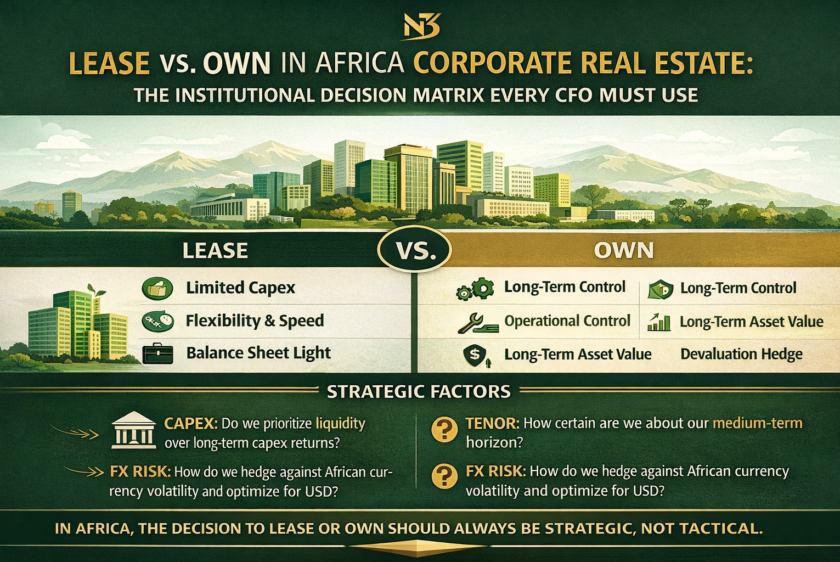
The Decision Matrix
Favor Ownership: Highly specialized facilities, strategic control essential, 25+ year occupancy certain AND excess capital available, sub-10% financing accessible
Favor Sale-and-Leaseback: Need capital for growth/debt reduction, core business ROIC >12%, reduce real estate concentration, strong credit profile
Favor Build-to-Suit Leasing: Expansion required but capital constrained, purpose-built specifications needed, transfer development risk